Someone finds the cause of a recurring issue, creates a small automation, helps a colleague through a difficult problem, or writes the runbook that saves time next week. The work matters—but it is often discussed once, then disappears from view. If useful work is invisible, how can a team learn from it, a manager recognise it, or a customer benefit from the improvement?
The model starts with lightweight daily capture in Azure DevOps, then turns that evidence into manager insight, shared learning and a fair four-week recognition cycle. The flow below shows how those steps connect—from individual contribution to better delivery and customer outcomes.
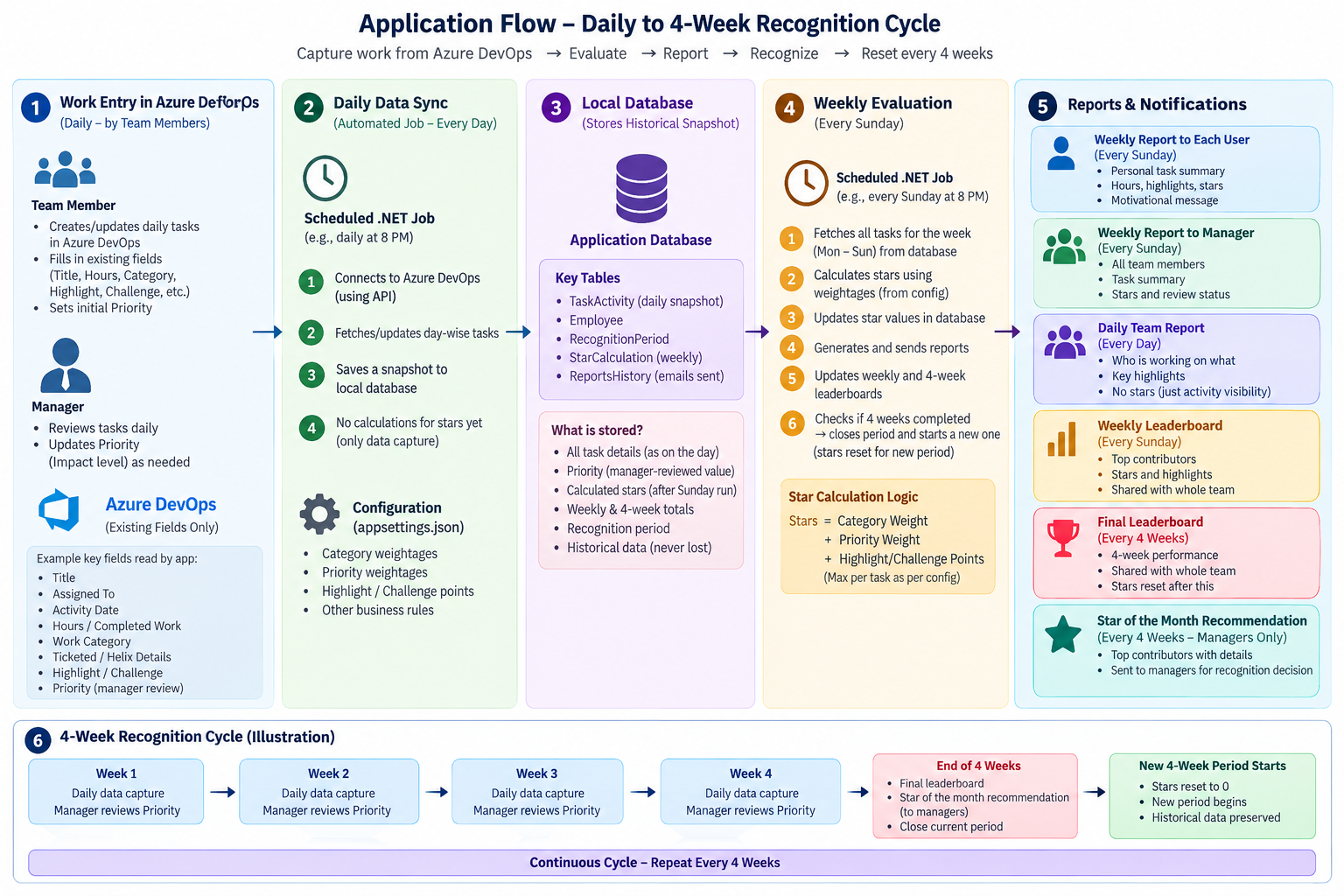
The idea
Keep day-to-day work in Azure DevOps, then add a light contribution layer around it. People capture useful work while it is still fresh; managers add context where it helps; and a scheduled process turns that information into reports, learning opportunities and a fair four-week recognition view. It does not ask the team to maintain another system.
The proposal in one minute
- Problem: valuable engineering work is often remembered in a conversation but not recorded after the meeting, incident or release has passed.
- Approach: use Azure DevOps to capture meaningful work, then use it to support useful review, shared learning and improvement.
- Outcome: clearer contribution for employees, less detective work for managers, more reusable practice for teams and more reliable service for customers.
- Guardrail: keep the conversation fair and motivating; never let ticket counts or points define a person's value.
How better engineering work reaches the customer
This is where the idea earns its keep. When useful work is visible, people can build on it, managers can remove recurring friction, and leaders can make better decisions. Over time, that gives customers a more reliable and responsive service.
| Level | Benefit |
|---|---|
| Employee | Useful work is visible; stronger evidence for one-to-ones, reviews and development conversations; recognition beyond ticket count; and supportive motivation through visible progress, appreciation and opportunities to share useful work. |
| Team | Better awareness of expertise, less duplicated investigation, more knowledge sharing, reusable runbooks and automation. |
| Manager | A clearer view of effort, recurring challenges and improvement opportunities, with reports that are easier to pull together for team conversations. |
| Senior leadership | Decision-ready insight into delivery themes, operational risks, capability growth, recurring friction and automation opportunities—not just task volume. |
| Customer / business | Faster and more consistent issue resolution, fewer repeated service interruptions and manual hand-offs, more reliable releases, clearer communication and stronger service continuity. |
| Engineering system | Work moves from capture to insight, then learning, reuse, improvement and more measurable delivery outcomes. |
A simple example. Imagine a recurring certificate issue that repeatedly pulls people into support. An engineer spots the pattern, builds a health-check automation, links the code and runbook in Azure DevOps, and shares it with the team. The next person does not have to start again; the manager can see the improvement; and customers experience a more reliable service.
In short: make valuable engineering work easier to see, use that insight to remove friction and spread good practice, and give customers a more reliable and responsive service as a result.
Collaboration and learning culture
A useful highlight can become a short knowledge-sharing session, a runbook, a small automation or a team standard. That is the real point of making contribution visible: not to create a scorecard, but to make good work easier to spread.
Why Azure DevOps?
Azure DevOps already has the basics this model needs: work items, assignments, history, permissions, attachments, comments, links, tags, queries and reporting. Starting there lets a team test the idea without first building another task-management application.
Automation should live with that evidence. An Automation task can link the Azure Repos pull request or repository, pipeline, runbook, deployment notes and the original problem it addressed. The work remains discoverable, reviewable and reusable after the person who created it has moved on.
Keep the recognition engine separate. Task capture and scoring should not be tightly coupled. Azure DevOps remains the system of work; the recognition layer supports reporting and discussion.
Fairness and safeguards
- Do not reward raw task count or task splitting.
- Do not multiply recognition by hours; report hours for context only.
- Preserve manager judgement.
- Use scores to support discussion, never to replace human assessment.
- Keep reminders supportive rather than punitive.
Recognition should be merit-based
The purpose is to make contribution easier to see and discuss fairly. Recognition should be based on the quality, impact and reviewed evidence of meaningful work.
Merit comes first. The score helps surface evidence; manager judgement, context and the value created for the team determine recognition.
Start with a small pilot
Start with one willing team for four weeks. Keep normal capture to 30–60 seconds, review a small sample each week, and look for one useful automation or knowledge-sharing opportunity. If something creates admin for its own sake, remove it. The first goal is to learn what genuinely helps the team—not to launch a finished scoring system on day one.
Adapt the model to your team
This is a core idea for improvement, not a fixed operating procedure. Teams can start with the parts that solve their immediate problem: lightweight daily capture, manager review, shared learning, automation visibility or better reporting.
Categories, review cadence, recognition rules and reporting detail should fit the team’s work, customer commitments and existing Azure DevOps process. Start small, learn what is useful, and keep only the parts that make work clearer, easier to share and better for customers.
How to know it is helping
- Less time spent reconstructing work for one-to-ones, reviews and status reports.
- More useful runbooks, knowledge-sharing sessions and reusable automations.
- Clearer recurring-problem signals and better release or support handovers.
- Evidence of fewer repeat manual checks, avoidable incidents or service interruptions where the team can measure them.
- No increase in administrative burden or unhealthy competition.